Wednesday, October 10, 2007

Follow the yellow brick road

It's evening in Kathmandu and I just got a helpful phonecall from our travel guy (I guess?) to let me know that all the flights for the last two days to our Himalayan destination Lukla had been cancelled due to weather. But I shouldn't worry, our 7:30am flight tomorrow will be ok. Whatever.
So either we'll be on a crack of dawn flight to the hills for a 16 day hike up near Everest... or I'll be back here slowly posting pictures. But assuming all goes well, we'll be on the trail until the 27th with nothing but our sleeping bags, 8 layers of clothing, cup-o-noodles and thoughts of you to keep us warm.

Run for the Border, the Hard Way

The route from Everest to the border first followed a dusty frontier trail through rolling hills with Himalayan backdrop. Finally hitting the "Tibet/Nepal Friendship Highway", we had road for 4 more hours before hitting a little outpost town just a couple hours off the border. The remaining road is under simultaneous con/de-struction and only open at night. Our plan was to circumvent this by sneaking in early in the morning before sunrise. It's a good plan and we're cruising on this one lane dirt/rock/rubble cliffside "road" by 7am.We slowly work our way through several sheep herds before sunrise (about 8:30 here) and then come across our first serious obstacle of the day, a cargo truck hanging precariously over 1000 foot drop - and blocking our passage. After a couple hours of discussion between the parties not involved, a bulldozer and backhoe work in harmony to simulateously upright and pull the truck to safety.A few more goatherds, several backhoes blocking the road and we make it to the actual border town. Unfortunately, this town is a one lane road that winds down a very steep hill. The cargo trucks waiting to cross block the single lane and makes passage to the immigration check and then across the 4 mile "no-man's land" to Nepal an incredibly time consuming act. Nepal immigration was a snap. We were practically dragged by border guards through the throngs of Chinese and Tibetan travellers massed around the entry gate and into Nepal before we even knew it.Then there's the 5 hour ride into Kathmandu. After a head-on bus accident, a flat tire, a couple goat herds and 4 hours we hit the thickest, grossest smog we'd ever seen. It's like there's a ring of soot around Kathmandu. Ugg. From there, it was an hour of horrible non-stop-honking traffic to get to the center of town and our hotel. All told, 12 long hours on the road for the day I chose to have food poisoning.

Smiling for the camera

This is us at the official Everest Base Camp sign in Tibet. John and I were already feeling the onslaught of AMS so just after this picture we got carted back to the tent and slumped down for the rest of the day. Even the next morning we were dosing in and out of consciousness so we drove down post haste. It wasn't until noon, and 7000ft lower that we started to recover.

Everest, the Easy Way

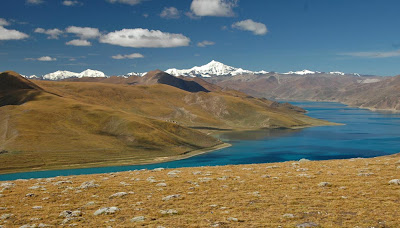
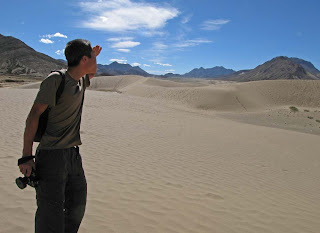
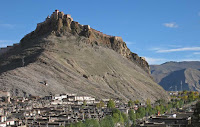
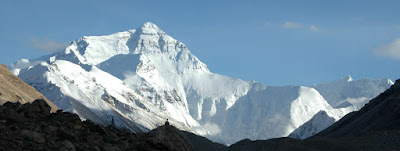
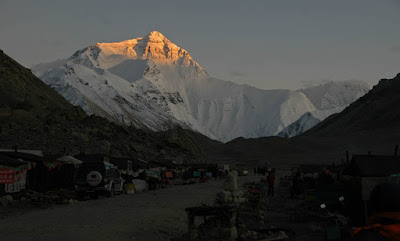
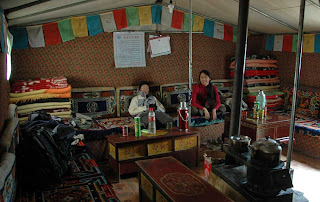
After Lhasa, we hopped into a 4x4 with our driver and government mandated and utterly useless "guide" for a 6 day trip through the countryside, out to Everest and on to the Nepal border. The landscape is so much more diverse than I imagined, and we saw only a small part. We started with the brilliant blue high mountain lake of Yadrok set against green hills and distant snowcapped peaks. We passed through sand dunes on our way to our first remote monastery. Unfortunately, remote here just means the hordes of tourists come together in big buses.Next stop, a monastery next to a fortress with a great dungeon. And there's no rules here, just a ladder into the darkness. Even better, -nobody- visits the fortress so we're all alone in the dark! Well, we hope we're alone...After a few quality frontier 'hotels' we won't talk about ever again, we closed in on Everest. The peak straddles the Tibet / China border and there is a "base camp" for climbing the on either side. The dubious 'beauty' of the Tibetan side is that you can drive a 4x4 right up to base camp and find a village of semi-permanent tent hotels and restaurants. And of course, the mountain jumps right out of the valley in front of you.Quomalangma as it is known here is a truly spectacular sight, but none of us see the sanity of risking your life to climb it.We had a little fun here when our guide and driver insisted we could not walk any further beyond the camp, even though we were pretty sure we could. So we did. A couple hour hike out, they meet up with us (in the 4x4) at a frontier police checkpoint and - call the cops on us! Seriously, other people are crossing a checkpoint without any interaction, but our wonderful guide actually gets us pulled into a guard shack where we argue over the validity of our permits and then they hold our passports to make sure we return! Actually, they finished by saying our permits were invalid and we needed to leave the country immediately. Good times. We continue on just a bit to a viewpoint and then return to catch our breath and our passports before heading down the hill to find a tent to spend a freezing night at 17,000 feet in.

Tibet, the New China

Tibet is not an easy place to get to. It is part of China, although China requires multiple "permits" in addition to the standard Chinese visa to get aroud. Of course, you can't get the permits anywhere other than Tibet (which you can't get to legally without a permit), so you have to work with a travel agent or similar intermediary who will do the legwork for you. The point is that they want you to be on a guided tour at all times where your actions and interactions with Tibetans can be controlled. We followed a pretty common western tourist route from Lhasa to the foot of Everest and then on to the Nepal border and it required two or three separate permits. Apparently venturing out into the untouristed northern or eastern parts of the country is incredibly difficult.It all seems a bit pointless to me as the Chinafication of Tibet since absorption in 1957 seems utterly complete. Lhasa itself is something like 80% Chinese. The countryside is claimed as largely Tibetan, but that just means the Chinese run the shops while the Tibetans farm or sell sourvenirs to tourists. The serious pilgrims at the monasteries are entirely Tibetan, but the monks are all Chinese! Road and store signs are always written in Chinese and sometimes in Tibetan. It is sad to see a culture slowly erased, but I suppose that happens. The Chinese people who have moved here and taken over are just like any other people looking for better opportunities. It's hard to blame anyone but a government trying to extend it's borders. It just means if you travel to Tibet go in expecting China.

The Ballad of Denise and Dave's Postcard

Writing postcards is fun when you find just the right one for someone. You write the note, address later when you have the address book handy and off it goes when you're lucky enough to find a stamp and postbox.So goes it with this uncanny visage of what could be Dave's Han forefather, a Xi'an terracotta warrior general. Quite unfortunately, I made the oh-so-simple mistake of misaddressing the card (to ourselves!) when doing that job a couple days later. Ok, no problem. It'll just wait until we get to Lhasa and I borrow some available double-sticky-sided tape, a slice of white paper and make my new address label. I grab a good pen to ensure legibility when writing out the new address.Then -BOOM, POW, KERSPLAT-. Ever open a rollerball pen that has seen a 17,000 foot change in altitude? So now the card is covered in ink; my hand is covered in ink; my FOOT is covered in ink. There's a bit of ink on the bed and floor where my body, shirt and pants couldn't protect. It's carnage and Mary and John can only look and laugh. Within the hour, I'm cleaned up and the work is finished. Denise, Dave - I don't know if this card will survive the Chinese postal inspectors, but know that truly unreasonable efforts were put into getting it to you.

Tuesday, October 02, 2007

On the road to Everest Base Camp, Tibet

We are packed, with way too much clothes and food, on this the eve of our Everest Base Camp attempt on the Tibet side. Okay, so all we're going to do tomorrow is sit in a car for 7hrs but that doesn't sound nearly as exciting. Over the next few days we'll be seeing the Tibetan mountainside, staying in villages, trying yak butter tea, gaining altitude and trying to acclimate. Our goal is to spend the night at the tents in base camp at 17,000ft with Mount Everest looming over head.

Given our earlier encounter with altitude sickness we're trying to take every precaution to make each step a success. This is testing ground for us as next we will be making the 15 day hike on the Nepal side to their Everest Base Camp. That will be much more challenging and physically demanding.

He's Alive!

Although I recovered from Acute Mountain Sickness, more commonly known as altitude sickness, after a day of sleeping, headaches, and throwing up... John was not so lucky. He stayed in bed for 2.5 days. Each day he was awake for maybe an hour total, coherent for much less than that. Finally on the 3rd day we threatened to have an IV shoved into him because he wasn't keeping any food down. I know Lhasa is technically China but none of us were in a rush to try out the needle inventory here. I think that did the trick because on the next day he was able to get out of bed and, more importantly, eat.

Now we're all back to mostly ourselves. The lower oxygen here at 11,000ft is making us out of breath just from walking around town. Another problem with the altitude is that all our shampoos, lotions, and pens are bursting but that's much more manageable.

Saturday, September 29, 2007

When it rains, it pours

I've had a lot of free time the last couple days, so there's been some good progress on photos. Albums from Malaysia, including our scuba adventures with Peter and John are up.

More exciting if you have plenty of bandwidth to steal from the boss, the video collection has quadrupled in size and is caught up through diving in Malaysia.

Enjoy!

Live from the train to the roof of the world

September 27th, depart Xining in Western China
10:15pm The "hard sleeper" cars on this train are crazy. Six bunks stacked 3 high in a narrow compartment with no door.

September 28th, somewhere on the rails to Lhasa
6:30am A thin band of sky sandwiched between the endless horizon and the low clouds is glowing a radiant yellow as sun rises over Tibet.

7am The cabin lights come on and the overhead speakers shout something at us before playing Chinese opera music. I guess it's time to get up.

10am We're running through snowcapped peaks. I'm sure our photos will show nothing but the intense white of the snow fading into the soft white of the clouds that blanket us.
12:15pm Mary and John can no longer handle the beauty. They retreat to their bunks to hide out for a while and see if they can shake the altitude sickness.

2:30pm Some people absolutely love riding trains. I'm finding it totally frustrating. Every time I pick up a book or startup the laptop, some amazing scenery shows up and I have to run and get the camera. It's really distracting. Worst part is that the only windows that open are in the bathrooms. Yech.

3pm John is still sleeping and Mary feels a bit queasy. I had a little shortness of breath quite a while ago, but it's been ok for a couple hours. I think we've already hit the 17,000 foot pass and should be heading back down, so hopefully they start feeling better soon.

3:20pm I just finished a whole package of wasabi peas. I've already finished catching up on our China photos and there's nothing left to do but eat and sleep!

4:30pm The plains just go on and on. Mary and John are still feeling a bit unwell and are back into bed. It's truly beautiful here, but it just keeps going! I'm almost bored with the constant beauty.
6pm Mary is feeling worse and John is still asleep. I just put her on oxygen to fight the altitude sickness. I'll go wake John up in a few minutes and get him on O2, too.

8:30pm The sun has gone down and left a brilliant royal blue background to the black mountains around us. It's a beautiful sight. Mary hasn't gotten any better with the O2 and both of them are still asleep. It's been a lonely day for me!

September 29th - Lhasa
12:15am Finally in bed! The train arrived by 11, but it took us half an hour to gather our gear (and Mary and John) and get out of the station. Luckily, the frantic hostel owner waited for us even though all other passengers and the train crew were already gone.

Wednesday, September 26, 2007

What the -bleep-?

We've finally gotten off our butts and posted a few blogs for the last 6 weeks of travel that covers Malaysia, Hong Kong, Macau and a bit of China.

It wasn't bad enough that it took so long for us to get moving, but when we did we found that the blog is banned in China. Apparently the Chinese censors can't handle all the uncontrolled content at blogspot.com, so they just block everything. So that's our excuse for the poor formatting (and writing?) in all the posts below - because we can't see what we're posting!

That's right, the blogspot domain is blocked so we can't see our final posts, but the censors haven't figured out that it is through blogger.com that all the objectionable content get's put on the web. Yes, we have peeked at it through an anonymizer, but that's just too slow and I'm too lazy...


Better yet for you non-readers out there, the photo albums for Indonesia are posted. Just click on Indonesia in the itinerary list to the right.

It's well past my bedtime now, so go read the blogs. We wake up in a couple hours to fly east to Xining where we'll catch the highest train in the world to Lhasa. Yay!

Monday, September 24, 2007

Now Serving 115,495,330

Mary didn't believe me at first when I said we should go to Beijing on this trip just to have roast duck. But I was serious. I had Peking Duck for the first time when we were here 2 years ago and it was a life altering experience. I vowed then that whenever I returned to China, I would come back to Beijing for dinner. She quickly succumbed to my plan and so we find ourselves now in Beijing.

We returned today to the 150 year old restaurant near the Forbidden City where they actually track the number of ducks they've served during that time to emperors, kings, presidents and us. It's a magical place, from the duck to the atmosphere, to the giant LED sign on the wall that tells you that duck number 115 million just popped out of the oven. Yeah, maybe it was a little touristy, but mmmmmm.

As we passed Tiananmen Square today, focused on our impending happiness, we stumbled not across the gate that leads to our ducky wonderland, but a giant wall enclosing block after block of the Qianmen district.

In preparation for the upcoming Olympics, this historic area that was home to houses, shops and our dinner is being razed to make way for a Chinese Santana Row which will have none of the character or charm of the original. Since this blog is being censored here anyway, I'll just say that it stinks that China is tearing chunks of real history and culture out (not to mention displacing how many families and small businesses) just to give Olympic tourists a Disney-fied China.

Fortunately for our stomaches, the Quanjude restaurant does have a temporary location until the reconstruction is complete, so we did get our fix. But it just wasn't the same. So tomorrow we'll try our host's recommendation for the new best roast duck in Beijing, serving #15,621.

-Steve

My Achy Breaky Knees

Our last (only?) Everest base camp warm-up hike before the real thing was to Huashan, a group of five mountain peaks a 2 hour bus ride from Xi'an. Locals go in droves to take the cable car up to the lowest peak and walk around a bit. Younger locals start at the bottom around midnight and hike up to the 6000ft eastern peak to catch sunrise. We're not local and no longer young, so we took the middle ground and started up the windy path from the bottom at 8am, did a circuit of all 5 peaks and stopped for the night at a hotel on the eastern peak at 7pm so we could more leisurely catch the 6am sunrise the next day. That's 10 hours (1hr for breaks) on an unrelenting stairmaster.


The trail is typical Chinese mountain style: narrow and random height steps cut into the mountain, often with a precipitous drop on either side. At its best, the steps are cut vertically into the face with a chain to pull yourself up. Half of the steps were only deep enough to land a third of my foot so we had to climb the stairs by sidestepping.


Then there's the "Plank Path", a completely insane set of dilapidated wooden boards set onto spikes set along a sheer cliff face a good 3000 feet off the valley floor below. I'm guessing a bit at the height here because I tried my best to not spend too much time looking down.

Sunday morning, we were yanked out of bed at 5:30 by a bullhorn announcement in Chinese that it was time to get up and run to the peak. At the top were a couple hundred cold locals, many of whom slept on the hill or just outside our door in rented heavy Chinese army winter coats.


Sunrise was beautiful, but a bit sad to see the sun rise not over the horizon as much as over the layer of smog that blanketed the horizon.


--Steve

Letting our fingers do the ordering

We don't know how to speak or read mandarin so when it came to reading Chinese menus we were sadly useless. We found the best way to satisfy the stomach was to point at what other people were chowing down. This ended up working very well as we got to taste some great stuff that we otherwise wouldn't have known to order.

Bowl of crossing bridge noodles famous in Xian. It only comes in one size, enormous.

Hot pot with spicy goodness, a Sichuan specialty.

Grilled skewers of pork, eggplant, stuffed buns, quail eggs, lotus root, tofu, mushrooms and so much more . Street food at its best in Jiuzhaigou.

If only Ansel Adams had been to Jiuzhaigou

Jiuzhaigou is one of the premier Chinese tourism locations with tens of thousands of locals visiting from all over China each week. The beauty of this national park is astounding if you can only get around all the other tourists shouting into their cell phones while bumping you to take a picture of their spouse in a Tibetan fur hat. It's an absolute zoo at the popular sights. We did our best by starting as soon as the park opened and walking the back country paths instead of taking the bus. That allowed us to take photos that make it SEEM like there aren't a thousand people around, but there really are in most cases.

All good destinations start with a good meal.
Pearl Shoals waterfall

The amazing color of 5 Flower Lake. No photoshop here.

Crystal clear waters of Panda Lake
Grilled skewers to finish off the trip