Wednesday, December 19, 2007

Teasers from Nepal

As if we're not proud enough of ourselves for finally writing some new blogs (thanks, Mary), I've posted photo albums from Tibet and hopeully will have the Nepal photos up before you read this. I promise they'll be done well before xmas. Here's a couple scenic shots to wet your appetite and make me feel like I did something useful this week.

In a near hallucinatory and frozen state, I started seeing snowmen. OK, that's a stretch, but my fingers were nearly frostbitten when I finished with yetiboy here.


Incredible vista from the 17,000+ foot top of Gokyo Ri, looking over the Gokyo glacier and back down the valley.

And here's what it was all about. One of about 5 photos we took above 18,000 feet on top of Kala Patthar before the freezing winds forced us back down. That would be Everest and Nupste (or Lhotse, I forget) in the background. Everest being the lower peak to the left.


The Nitty Gritty

Not showering for 2 weeks wasn't as bad as I had thought. Sure there were showers available but they were outdoor and the stream fed water would've snapped my hair off. The occasional wet wipe was good enough. For the entire 14 days we were constantly freezing so we never took off our base layer except to quickly change once at the half way point. Well, some of us did. I think the socks probably took the hardest hit. You know it's been a rough hike when you can see the smell wafting off your feet. Really.

It wasn't until we were back in the warmth of Kathmandu that we showered and for the first week our skin slowly sloughed off several layers. It was like we were shedding two weeks worth of skin and dirt all at once.


We stumbled upon just a couple nice bathrooms. Indoor, porcelain and with a door!


Here's one of the most beautiful outhouses in the world, but you really did not want to get stuck going out to it in the middle of the night. Although somebody "smart" propped their tent right next to it.

Wallowing in Dung

Yak dung is brown, but it's gold. It's lovingly hand shaped into convenient patties for drying.Their uses are universal; from making walls, to indoor carpeting, to beds, and most importantly stove fuel. Ah, the smell of yak dung meant warmth.Of course we tried desperately not to notice that the same hands handling the patties then went directly into the kitchen to take care of our dinner. That was one of those taboo subjects.

Yak Sizzler that really sizzles

If only we could've eaten that well the entire 2 week trek. But the culinary offerings of Namche Bazaar is far and away the exception in this the largest and lowest town on the beaten path. Our Himalayan vacation was largely powered by egg and toast in the morning, instant Rara noodles for lunch, and the local lentil soup called dahl bat for dinner. All this was washed down by hot tea, hot lemon, or boiled water. Every guesthouse had the same bland items. After the first few days we started eating as a chore. Though we'd be starving after a six hour hike uphill we'd pick at our food just enough to stave off hunger yet another night. At the base of Mt. Everest we were treated to a left over bag of chili mix from a previous expedition. Of course the local Nepalese cooks hadn't the faintest idea of what to do with it so I squandered my way into a kitchen, not that I knew how to make RV food but atleast I could read the instructions. We had brought a weighty bag of snacks to offset our limited diet. The snickers bars, skittles, sour lemon drops and sausages were all highlights in our daily regiment.We semi-unfortunagtely learned that skittles, lemon drops and happy cola combined under heat and pressure mutate into a single gelatenous brick of pure sugar. Of course, that didn't stop us from gnawing on the brick as Mary demonstrates here.
Oh sure, along the road up snacks like crackers, canned fruit, and chocolate could be found but at $5 per snickers we were glad we bought our own. Even with this gold mine of snacks our daily intake of calories were well under the amount spent traversing the mountains. Over the 14 days we lost at least 10lbs each, with Steve being the most drastic with his 20lb loss. We were all swimming under layers of wool and goretex. So even with our gorgings on Yak sizzler and gorgeous chocolate cake during our two stops at Namche Bazaar our 2 week circuit that took us above Everest Base Camp was an awesome weight loss program. The bonus was walking away with legs of steel.

Dhanyabaad Mr. Roboto

Cold weather causes tremendous shrinkage in the life of a battery leaving it with only 10% of its normal usage. We confirmed this during our trip to the Harbin Ice Festival 2yrs ago. Thus the livelihoods of our combined 3 cameras were at risk. 'Isn't there electricity in the Himalayas?' you ask. The answer is sort of. The 'fancier' guesthouses have a single 15watt bulb in the common eating room that they light from 6-9pm. Outlets? Never saw one. But some entrepreneurial spirits have brought a handful of solar panels to supply tourists with their precious juice. So anyone wanting a charge could pay $5/hr. Just hope your battery recharges quickly. Even then people were only getting half charges due to questionable wiring. But that's why we bring someone along with too much time and no sensible fear of electrical fire hazard. When John first walked off the airport bus way back in Beijing my first question to him was 'What's that on your back?" He looked like a Teenage Mutant Ninja Turtle living in the Matrix. But that's how solar panels on your back are going to change your image. Oh sure there were the common enough glares by locals and tourists alike. They spat out questions like 'What is that?', 'Does it work?', and 'Is that what I think it is?'. And yes, it worked like a charm. Even came with a built in flashlight. We put in a request that next time he jerry rig a heater, or air conditioner as befits the environ.

The Regiment

Up at 6am, not rested but awake. It's 15F, inside the room. There's a painful dryness deep in your throat, maybe as far as your lung. Your breath crystalizes in front of you. You brush with whatever water didn't freeze in the bottle. Force down toast, again. If you thought it was cold indoor, outside there's a considerable windchill factor. Then you hit the road one uphill step at a time. Your fingers and toes are the first to freeze, the kind that hurt your bones. Every morning the first 300ft always seem to be the hardest. Breathing is like sucking dry ice through a straw with a leak in it. It's easiest to stare a few steps ahead, but you can't forget to look up and around at the scenery. That's what you're there for after all. Surely this torment must be for some reason. You scan ahead of you to see where the sherpa is leading, and somehow it's almost always up. Sometimes the worst is down because that just means there's even more up ahead. Now and then there is no worn path so you just have to make your own through the boulder fields hopping from one to the next. The icy spots are the worst. Squeezing past the Yaks takes a bit of finesse and when they're behind you it feels like special olympics version of running of the bulls. Yak's horns are just as sharp and long, and they really don't care where they point them. Lunch is an opportunity to warm up with hot lemon or tea. But you don't want to stop too long because the icy winds pick up after noon and the there's a lot more mountain to climb before you can settle for the night. And your muscles tighten up in this cold if you stop moving. To make matters worst it's the high season so you have to get to the next village early enough to get a bed. The afternoon hike is much like the morning. The chill from being in the sun's shadows is replaced by the bony chilling gusts that penetrates through your fleece. Usually the face gets hit the hardest. Your nose is red and raw from wiping, your ears act as conduits for a perpetual brain freeze, and your eyeballs feel like ice cubes rolling around in your head. Finally you see your destination. At about 4pm you reach the guesthouse and change out of your hiking shoes and socks to give them a chance to dry. Now's the time a shower so grab a wet wipe and you're done in a minute. Grab your book and head into the common room. There's a single stove in the middle of the room and that only gets lit from 6-9pm, same as the sole light bulb. Dinner is usually served around 6pm so you're in bed by 8pm. You're exhausted so even though the elevation won't let you sleep it's still good just to lay down. Hopefully there's extra blankets because your 15F sleeping bag doesn't cut it even with 3 layers of clothes on. Hours later sleep finally arrives and you wake up the next morning to do it all over again. And though it's grueling, physically torturous, and each day is a journey into the unknown the experience is magnificient and you wouldn't trade it for all the comforts of home.

Airport insecurity

To get from the warm, comfortable lower lands of Kathmandu to the epic ranges of the Himalayas we would need to take a 40min roller coaster of a double prop plane ride. Surviving the aerial acrobatics would prove to be the easy part, after all there was nothing we could do about that. The tough part is actually getting on the plane. October is supposed to be the good predictable weather season so planes can take off and land from the parking lot sized tarmac in Lukla, the base of trekking. Trouble was the weather the week before was unseasonably cloudy so no one was flying. When we got to the airport just after 5am the place was a zoo. Locals and tourists were all huddled along the walls, counters, and floors; any available space to lean, sit or lay on. But then this was Nepal so maybe that's what it looks like on any day. One by one the flights were being delayed, then cancelled. Other travellers were sharing their grief as this was their 3rd day waiting at the airport for the chance of getting a flight. Finally at 4pm they cancelled our flight so we headed back to the hotel. Imagine the stupidest ticketing system that is the antithesis of sensibility and efficiency and that's what we battled to get tickets for another flight. With a week of back up securing a seat was like digging for gold. Luckily we found one two days later. Less fortunate individuals didn't even have the flexibility in their limited trip dates to make another try. Well, our 2nd day there was even more ridiculous. We camped out on an unused luggage rack as the hoards of people and their excess baggage cramped the small, stuffy building. No information was being given about whether or not any tickets were going to be usable that day so everyone was in a state of mutual exasperation. It was the Wild West of airports. There were no such thing as lines, rules, or security. Somehow I found myself with the task of pestering the head honcho of the airline we were supposed to fly with. Oh sure he tried to wave me off the first few times with waiting times grabbed out of thin air but then I stuck with him like a bad haircut until he gave me something concrete. By noon there was confirmation from Lukla airport that the clouds were clearing so their airport would open up. That made my resolve to annoy him until he got us on a flight grow. At one point the stress was so much for the guy standing next to me that he went into a grand mal seisure and had to be taken away. When push came to shove I squeezed myself to the front of the line and climbed over the counter to make sure our names were written on the passenger manifest. What was at risk was the entire 2 week trek to Everest itself. It was such a relief make it up to the mountain and not have to resort to Plan B because we didn't have one. We honestly had settled ourselves on having to give up Everest and didn't think we'd make it. Having conquered that trial we had a bounce in our step, but it wouldn't last long. There was still the flight back to consider.

Wednesday, October 10, 2007

Follow the yellow brick road

It's evening in Kathmandu and I just got a helpful phonecall from our travel guy (I guess?) to let me know that all the flights for the last two days to our Himalayan destination Lukla had been cancelled due to weather. But I shouldn't worry, our 7:30am flight tomorrow will be ok. Whatever.
So either we'll be on a crack of dawn flight to the hills for a 16 day hike up near Everest... or I'll be back here slowly posting pictures. But assuming all goes well, we'll be on the trail until the 27th with nothing but our sleeping bags, 8 layers of clothing, cup-o-noodles and thoughts of you to keep us warm.

Run for the Border, the Hard Way

The route from Everest to the border first followed a dusty frontier trail through rolling hills with Himalayan backdrop. Finally hitting the "Tibet/Nepal Friendship Highway", we had road for 4 more hours before hitting a little outpost town just a couple hours off the border. The remaining road is under simultaneous con/de-struction and only open at night. Our plan was to circumvent this by sneaking in early in the morning before sunrise. It's a good plan and we're cruising on this one lane dirt/rock/rubble cliffside "road" by 7am.We slowly work our way through several sheep herds before sunrise (about 8:30 here) and then come across our first serious obstacle of the day, a cargo truck hanging precariously over 1000 foot drop - and blocking our passage. After a couple hours of discussion between the parties not involved, a bulldozer and backhoe work in harmony to simulateously upright and pull the truck to safety.A few more goatherds, several backhoes blocking the road and we make it to the actual border town. Unfortunately, this town is a one lane road that winds down a very steep hill. The cargo trucks waiting to cross block the single lane and makes passage to the immigration check and then across the 4 mile "no-man's land" to Nepal an incredibly time consuming act. Nepal immigration was a snap. We were practically dragged by border guards through the throngs of Chinese and Tibetan travellers massed around the entry gate and into Nepal before we even knew it.Then there's the 5 hour ride into Kathmandu. After a head-on bus accident, a flat tire, a couple goat herds and 4 hours we hit the thickest, grossest smog we'd ever seen. It's like there's a ring of soot around Kathmandu. Ugg. From there, it was an hour of horrible non-stop-honking traffic to get to the center of town and our hotel. All told, 12 long hours on the road for the day I chose to have food poisoning.

Smiling for the camera

This is us at the official Everest Base Camp sign in Tibet. John and I were already feeling the onslaught of AMS so just after this picture we got carted back to the tent and slumped down for the rest of the day. Even the next morning we were dosing in and out of consciousness so we drove down post haste. It wasn't until noon, and 7000ft lower that we started to recover.

Everest, the Easy Way

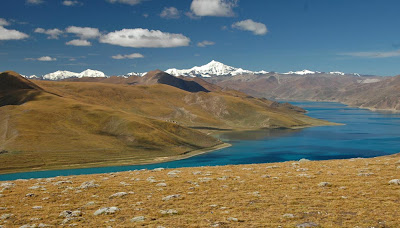
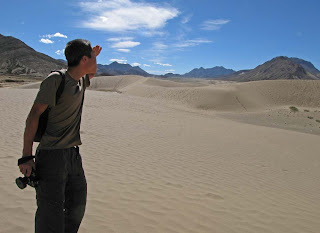
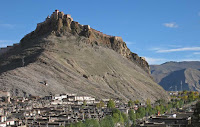
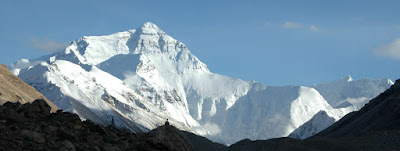
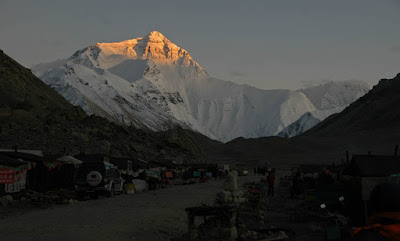
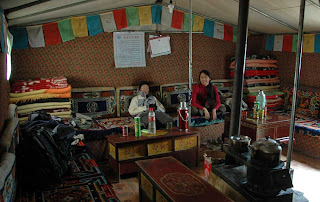
After Lhasa, we hopped into a 4x4 with our driver and government mandated and utterly useless "guide" for a 6 day trip through the countryside, out to Everest and on to the Nepal border. The landscape is so much more diverse than I imagined, and we saw only a small part. We started with the brilliant blue high mountain lake of Yadrok set against green hills and distant snowcapped peaks. We passed through sand dunes on our way to our first remote monastery. Unfortunately, remote here just means the hordes of tourists come together in big buses.Next stop, a monastery next to a fortress with a great dungeon. And there's no rules here, just a ladder into the darkness. Even better, -nobody- visits the fortress so we're all alone in the dark! Well, we hope we're alone...After a few quality frontier 'hotels' we won't talk about ever again, we closed in on Everest. The peak straddles the Tibet / China border and there is a "base camp" for climbing the on either side. The dubious 'beauty' of the Tibetan side is that you can drive a 4x4 right up to base camp and find a village of semi-permanent tent hotels and restaurants. And of course, the mountain jumps right out of the valley in front of you.Quomalangma as it is known here is a truly spectacular sight, but none of us see the sanity of risking your life to climb it.We had a little fun here when our guide and driver insisted we could not walk any further beyond the camp, even though we were pretty sure we could. So we did. A couple hour hike out, they meet up with us (in the 4x4) at a frontier police checkpoint and - call the cops on us! Seriously, other people are crossing a checkpoint without any interaction, but our wonderful guide actually gets us pulled into a guard shack where we argue over the validity of our permits and then they hold our passports to make sure we return! Actually, they finished by saying our permits were invalid and we needed to leave the country immediately. Good times. We continue on just a bit to a viewpoint and then return to catch our breath and our passports before heading down the hill to find a tent to spend a freezing night at 17,000 feet in.
Tibet, the New China

Tibet is not an easy place to get to. It is part of China, although China requires multiple "permits" in addition to the standard Chinese visa to get aroud. Of course, you can't get the permits anywhere other than Tibet (which you can't get to legally without a permit), so you have to work with a travel agent or similar intermediary who will do the legwork for you. The point is that they want you to be on a guided tour at all times where your actions and interactions with Tibetans can be controlled. We followed a pretty common western tourist route from Lhasa to the foot of Everest and then on to the Nepal border and it required two or three separate permits. Apparently venturing out into the untouristed northern or eastern parts of the country is incredibly difficult.It all seems a bit pointless to me as the Chinafication of Tibet since absorption in 1957 seems utterly complete. Lhasa itself is something like 80% Chinese. The countryside is claimed as largely Tibetan, but that just means the Chinese run the shops while the Tibetans farm or sell sourvenirs to tourists. The serious pilgrims at the monasteries are entirely Tibetan, but the monks are all Chinese! Road and store signs are always written in Chinese and sometimes in Tibetan. It is sad to see a culture slowly erased, but I suppose that happens. The Chinese people who have moved here and taken over are just like any other people looking for better opportunities. It's hard to blame anyone but a government trying to extend it's borders. It just means if you travel to Tibet go in expecting China.

The Ballad of Denise and Dave's Postcard

Writing postcards is fun when you find just the right one for someone. You write the note, address later when you have the address book handy and off it goes when you're lucky enough to find a stamp and postbox.So goes it with this uncanny visage of what could be Dave's Han forefather, a Xi'an terracotta warrior general. Quite unfortunately, I made the oh-so-simple mistake of misaddressing the card (to ourselves!) when doing that job a couple days later. Ok, no problem. It'll just wait until we get to Lhasa and I borrow some available double-sticky-sided tape, a slice of white paper and make my new address label. I grab a good pen to ensure legibility when writing out the new address.Then -BOOM, POW, KERSPLAT-. Ever open a rollerball pen that has seen a 17,000 foot change in altitude? So now the card is covered in ink; my hand is covered in ink; my FOOT is covered in ink. There's a bit of ink on the bed and floor where my body, shirt and pants couldn't protect. It's carnage and Mary and John can only look and laugh. Within the hour, I'm cleaned up and the work is finished. Denise, Dave - I don't know if this card will survive the Chinese postal inspectors, but know that truly unreasonable efforts were put into getting it to you.

Tuesday, October 02, 2007

On the road to Everest Base Camp, Tibet

We are packed, with way too much clothes and food, on this the eve of our Everest Base Camp attempt on the Tibet side. Okay, so all we're going to do tomorrow is sit in a car for 7hrs but that doesn't sound nearly as exciting. Over the next few days we'll be seeing the Tibetan mountainside, staying in villages, trying yak butter tea, gaining altitude and trying to acclimate. Our goal is to spend the night at the tents in base camp at 17,000ft with Mount Everest looming over head.

Given our earlier encounter with altitude sickness we're trying to take every precaution to make each step a success. This is testing ground for us as next we will be making the 15 day hike on the Nepal side to their Everest Base Camp. That will be much more challenging and physically demanding.

He's Alive!

Although I recovered from Acute Mountain Sickness, more commonly known as altitude sickness, after a day of sleeping, headaches, and throwing up... John was not so lucky. He stayed in bed for 2.5 days. Each day he was awake for maybe an hour total, coherent for much less than that. Finally on the 3rd day we threatened to have an IV shoved into him because he wasn't keeping any food down. I know Lhasa is technically China but none of us were in a rush to try out the needle inventory here. I think that did the trick because on the next day he was able to get out of bed and, more importantly, eat.

Now we're all back to mostly ourselves. The lower oxygen here at 11,000ft is making us out of breath just from walking around town. Another problem with the altitude is that all our shampoos, lotions, and pens are bursting but that's much more manageable.